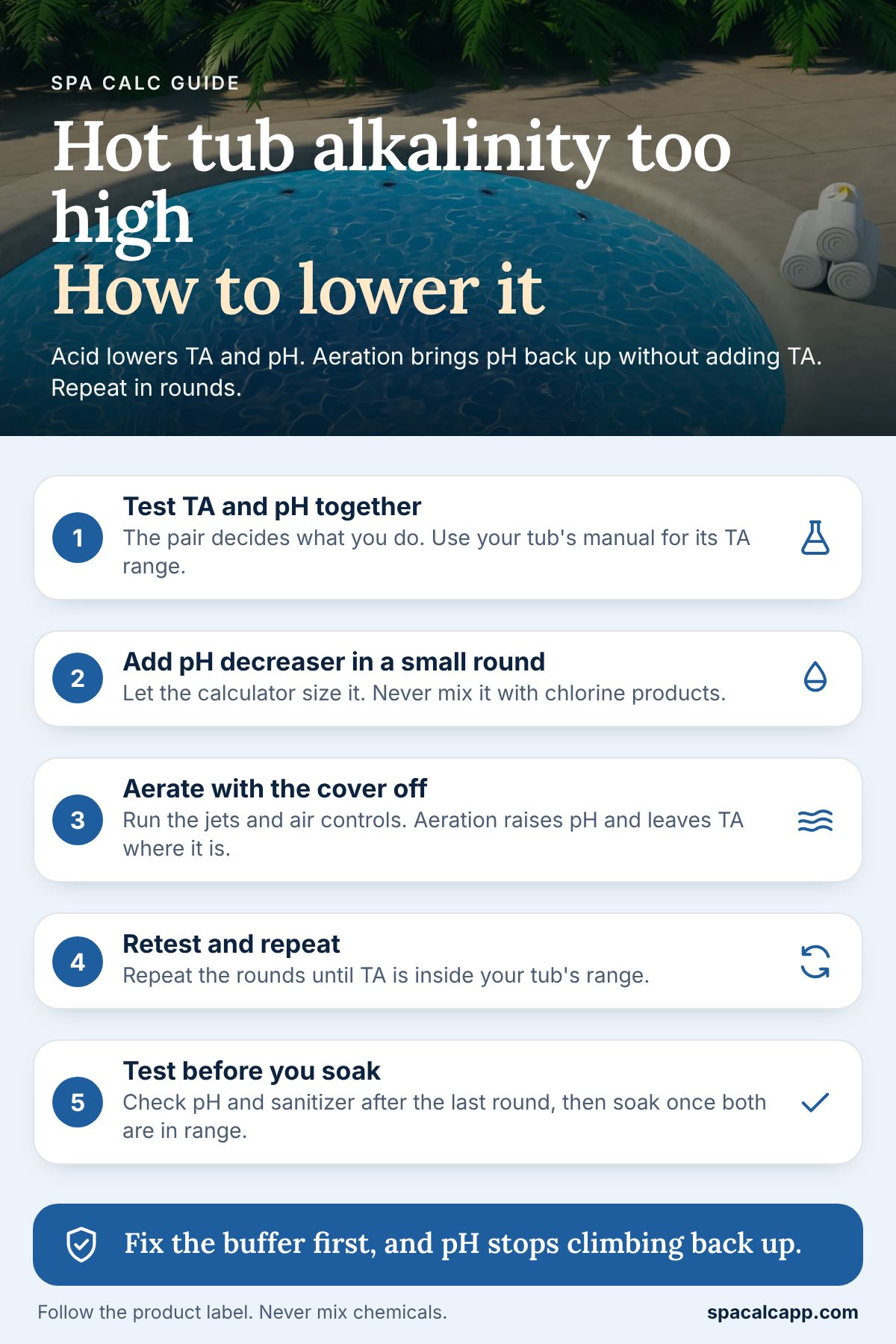
The quick answer: when your hot tub alkalinity is too high, lower it with a pH decreaser (acid) in small rounds. Acid brings down both total alkalinity (TA) and pH. Then run the jets with the cover off to raise pH again, since aeration lifts pH without adding TA. As a guide, about 1.4 oz (39 g) of sodium bisulfate (~93%) lowers TA by 10 ppm in a 400 gallon tub, or about 39 g in 1,500 litres. Follow the product label.
Hot tub pH and alkalinity calculator
Add
0.4oz
of Dry acid / pH minus (sodium bisulfate 93%)
11 gabout 2 tsp by volume
Lowers pH from 7.9 to 7.5 in 400 gal at TA 80.
- Side effects: TA −2.9 ppm.
- Run the jets with the lid open and wait at least 15 minutes (20 after pH decreaser) before anyone gets in.
- Never add acid and chlorine together or in the same spot: mixing them releases toxic chlorine gas. Let the first one circulate before adding the other (the wait is shown on each step).
- Pour it slowly in front of a return jet with the pump running.
- Retest after the water has circulated.
Check the product label. Strengths vary by brand, so enter the % printed on yours. Add one chemical at a time, into the water, and never mix chemicals.
Save this test and get a reminder before your next soak.
Want this every time you test?
Spa Calc remembers your hot tub and tells you if it’s ready to soak, and what to add, every time you test.
Spa Calc for iPhone
What high alkalinity means
Total alkalinity is the water's buffer against pH change. Taylor Technologies calls water with too much TA overbuffered. A little buffer keeps pH steady; too much makes pH drift upward and resist your corrections.
How high is too high depends on the source:
| Source | TA range |
|---|---|
| Bullfrog water care instructions | 80 to 120 ppm |
| Jacuzzi manual | 80 to 150 ppm |
| Taylor Technologies | ideal 80 to 120, maximum 180 ppm |
| TroubleFreePool spa guide | 50 to 90 ppm |
Use your own tub's manual first. Bullfrog says to bring TA into range before adjusting pH, even if that throws pH off further for a while.
Why it's high
- Your fill water. TroubleFreePool notes that TA rises with high-TA fill water. If it's high right after a refill, your tap water is the likely source.
- Alkalinity increaser or baking soda. Every dose adds TA. Taylor notes that sodium bicarbonate raises TA and only slightly raises pH, so it's easy to overshoot when you're trying to fix pH.
- pH increaser. TroubleFreePool notes that soda ash raises both pH and TA.
Why pH keeps rising with it
Hot tubs aerate the water every time the jets run. TroubleFreePool's spa guide says pH often rises in a hot tub because of aeration, and its aeration article explains why: carbon dioxide leaves the water, which raises pH, and "the higher the TA, the faster the pH will rise." So with high TA you lower pH, and a day later it's back up. Lowering TA breaks that loop. If your pH is high too, see hot tub pH too high.
How to lower it, step by step
Step 1: Test TA and pH together. The pair decides what you do. If TA is high but pH is low, the alkalinity high, pH low guide covers that case. Log both readings in Spa Calc for iPhone so you can follow each round.
Step 2: Work out the dose. Enter your TA, pH and volume in the pH and alkalinity calculator. TroubleFreePool notes that acid lowers TA but also lowers pH, so work in small steps and let the calculator size each one. Not sure of your volume? See how many gallons in a hot tub.
Step 3: Add the pH decreaser, a small round at a time. One maker's spa pH decreaser lists sodium bisulfate as its active ingredient, and its safety data sheet warns never to mix it with chlorine products. Follow the product label, and add chemicals to water, never water to chemicals. Don't let pH fall below 7.0.
Step 4: Aerate to bring pH back up. Run the jets and open the air controls with the cover off. TroubleFreePool says aeration raises pH while leaving TA where it is, and that lots of small bubbles work best. This is the half of each round that lets TA keep falling without pH crashing.
Step 5: Retest and repeat. Test TA and pH again once the water has circulated. Repeat the rounds until TA is inside your tub's range. Jacuzzi's manual says that when alkalinity is high, it is advisable to drain the tub and start the balancing again.
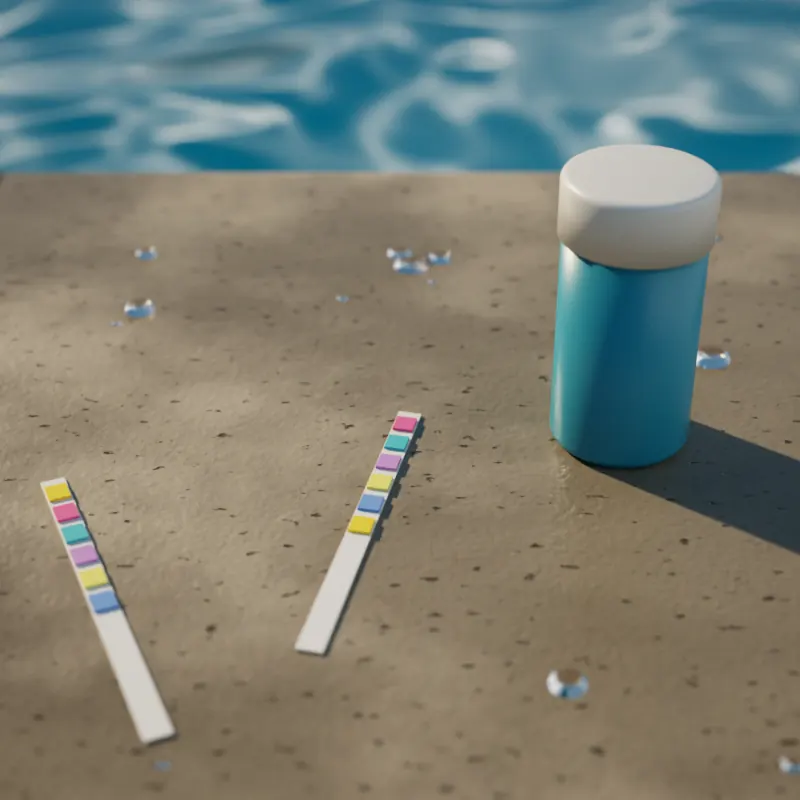
When can you soak? After the last round, test pH and sanitizer. Soak when free chlorine is 3 to 5 ppm and at least 7.5% of your CYA (bromine 4 to 6) and pH is 7.2 to 7.8, at least 15 minutes after adding anything (20 after pH decreaser); after chlorine, bromine or a shock, test again first. Above 5 ppm chlorine or 6 ppm bromine, wait and retest in an hour or two; never soak above 10 ppm chlorine or 8 ppm bromine, or with pH below 7.0 or above 7.8. Below 3 ppm chlorine (4 bromine), add sanitizer first; at pH 7.0 to 7.2, raise pH first; with CYA above 40 ppm, drain and refill. Hot tub limits based on CDC guidance and EPA product labels.
How to keep it from creeping back up
- Test TA after every refill, since fill water sets your starting point.
- Add alkalinity increaser only when TA is actually low, and in small steps.
- Don't use soda ash to fix low pH when TA is already high; aeration raises pH without adding TA.
- Keep pH decreaser doses small, and let the calculator size them.
Common mistakes
- Lowering pH again and again without fixing TA. pH will keep rising while TA stays high. Fix the buffer first.
- Adding a big dose at once. A large acid dose can drop pH below the safe range. Small rounds are easier to correct.
- Skipping the aeration step. Without it, pH stays low and the next acid dose drops it further.
- Losing track of rounds. Spa Calc keeps every reading and dose in one log, so you can see TA falling round by round.
Track it in Spa Calc
Spa Calc works out each pH decreaser step from your readings and your tub's volume, keeps your tests in one log, and shows whether the water is ready to soak. Get Spa Calc for iPhone and log your next test.
Sources
- TroubleFreePool: Spa and Hot Tub Maintenance, A Basic Guide: spa TA range; pH often rises in a hot tub because of aeration.
- TroubleFreePool: Managing pH and Total Alkalinity: acid lowers TA and pH; aeration raises pH without affecting TA; TA rises with high-TA fill water.
- TroubleFreePool: Aeration: CO2 leaving the water raises pH; the higher the TA, the faster pH rises; aeration is used when lowering TA; small bubbles work best.
- Taylor Technologies: Your Pool's Total Alkalinity Explained: TA ranges for pool or spa water; overbuffered water; bicarbonate raises TA and only slightly raises pH.
- Bullfrog Spas: Water Care Instructions: TA range; bring TA into range before pH; follow the chemical package instructions.
- Jacuzzi: Alexa owner's manual: TA range; drain and rebalance when alkalinity is high.
- TroubleFreePool: Pool Care Basics, recommended pool chemicals: soda ash raises both pH and TA; aeration raises pH without raising TA.
- HASA: Hi-Temp Spa pH Decreaser safety data sheet and product page: sodium bisulfate lowers pH and alkalinity; do not mix with chlorine bleach.
- CDC: Controlling Legionella in Hot Tubs (toolkit): hot tub pH control range 7.2–7.8.
- Every dose and limit on this page comes from the same chemistry engine as Spa Calc.
Safety
- Keep chemicals out of reach of children and pets, and keep them out of the water until it is back in range.
- Never mix chemicals. Never add acid and chlorine together: mixing them releases toxic chlorine gas.
- Add chemicals to water, never water to chemicals.
- Store chemicals sealed, cool and dry, apart from each other.
- Read and follow the product label. It always comes first.