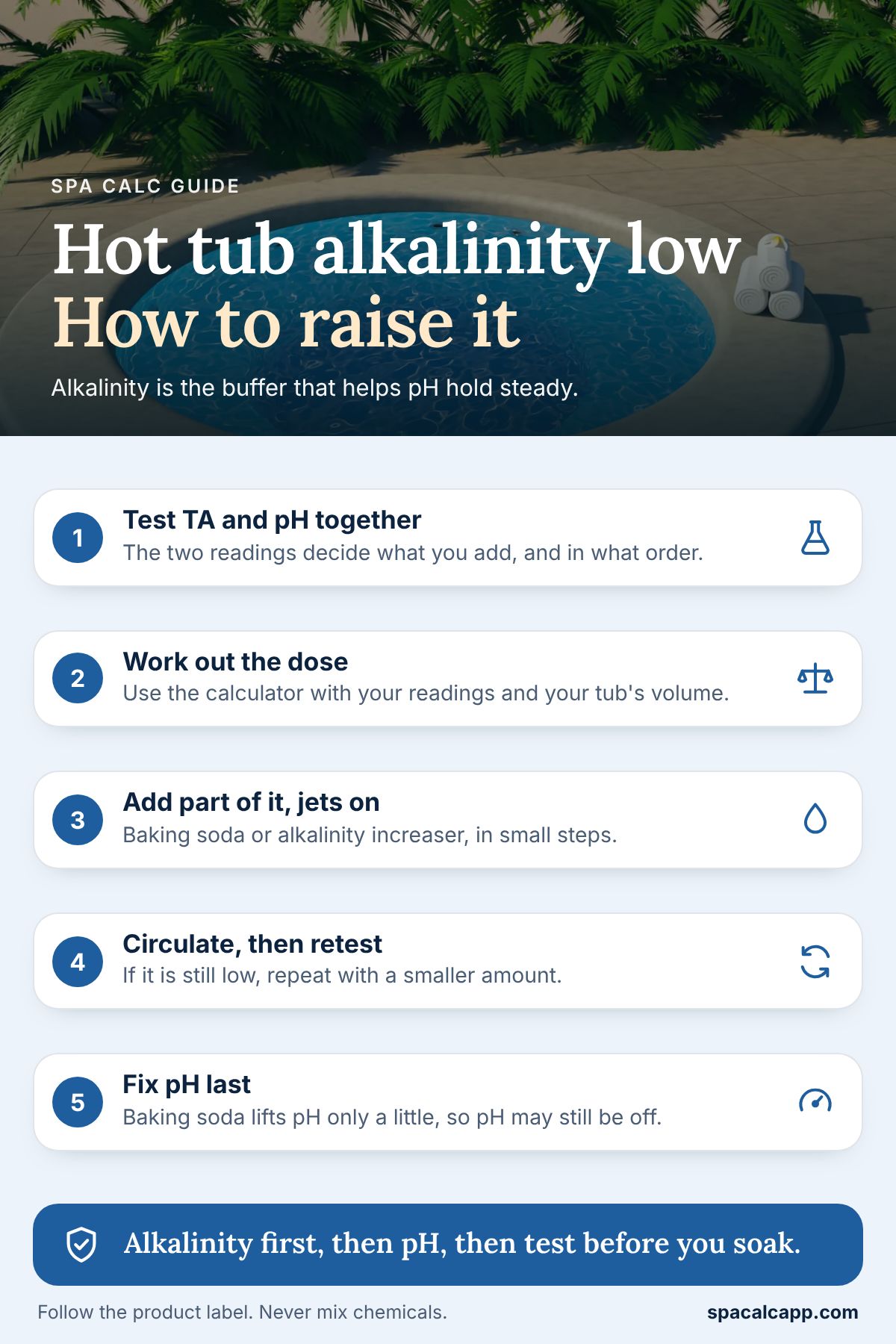
The quick answer: when your hot tub alkalinity is low, add baking soda or an alkalinity increaser in small steps, with the jets running, and retest before adding more. About 0.9 oz (25 g) raises total alkalinity (TA) by 10 ppm in a 400 gallon tub, or about 25 g in 1,500 litres. Follow the product label.
Hot tub pH and alkalinity calculator
Add
0.4oz
of Dry acid / pH minus (sodium bisulfate 93%)
11 gabout 2 tsp by volume
Lowers pH from 7.9 to 7.5 in 400 gal at TA 80.
- Side effects: TA −2.9 ppm.
- Run the jets with the lid open and wait at least 15 minutes (20 after pH decreaser) before anyone gets in.
- Never add acid and chlorine together or in the same spot: mixing them releases toxic chlorine gas. Let the first one circulate before adding the other (the wait is shown on each step).
- Pour it slowly in front of a return jet with the pump running.
- Retest after the water has circulated.
Check the product label. Strengths vary by brand, so enter the % printed on yours. Add one chemical at a time, into the water, and never mix chemicals.
Save this test and get a reminder before your next soak.
Want this every time you test?
Spa Calc remembers your hot tub and tells you if it’s ready to soak, and what to add, every time you test.
Spa Calc for iPhone
What low alkalinity means
Total alkalinity is the water's buffer against pH change. Taylor Technologies calls low-TA water underbuffered and says it leads to "pH bounce," where pH moves around after small additions. Bullfrog's owner's manual says the same thing plainly: pH gets unstable and hard to control.
How low is low depends on the source:
| Source | TA range |
|---|---|
| Bullfrog water care instructions | 80 to 120 ppm |
| Jacuzzi manual | 80 to 150 ppm |
| Taylor Technologies | minimum 60, ideal 80 to 120 ppm |
| TroubleFreePool spa guide | 50 to 90 ppm |
Use your own tub's manual first. Jacuzzi's manual warns that TA below 60 ppm could be corrosive. TroubleFreePool warns that below about 50 ppm, pH can crash suddenly.
Why it drops
- Acid additions. TroubleFreePool notes that every acid addition lowers TA, including pH decreaser. If you've been chasing high pH, this is the first place to look. The alkalinity high, pH low guide covers the opposite problem.
- Non-chlorine shock (MPS). By Spa Calc's chemistry engine, 1 oz of 45% MPS uses up about 4.2 ppm of TA in a 400 gallon tub. Weekly shocks add up.
- Trichlor tablets. TroubleFreePool notes that trichlor lowers both pH and TA. Bullfrog says never to use it in a portable spa.
- Your fill water. A fresh fill sets your starting point, so TroubleFreePool's spa guide says to test once the tub is full.
How to raise it, step by step
Step 1: Test TA and pH together. The two readings decide what you add, and in what order. Note both in Spa Calc for iPhone so you can see the change.
Step 2: Work out the dose. Enter your readings and volume in the pH and alkalinity calculator. As a guide, going from 50 to 80 ppm in a 400 gallon tub takes about 2.7 oz (76 g) of baking soda. Not sure of your volume? See how many gallons in a hot tub.
Step 3: Add part of it, jets on. TroubleFreePool suggests no more than about 20 ppm at a time. Bullfrog says to add small doses with the jets running. Follow the product label, and add chemicals to water, never water to chemicals.
Step 4: Let it circulate, then retest. Bullfrog says to wait 6 hours before testing again. If the reading is still low, repeat with a smaller amount.
Step 5: Fix pH last. Bullfrog's order is alkalinity first, then pH. Baking soda lifts pH only a little, so pH may still be off.
- pH still low: see hot tub pH too low.
- pH high: lower it in small steps. If TA ends up above range instead, see hot tub alkalinity too high. Acid also lowers TA, so use the calculator. We don't give a fixed amount here because it depends on your readings. See hot tub pH too high.
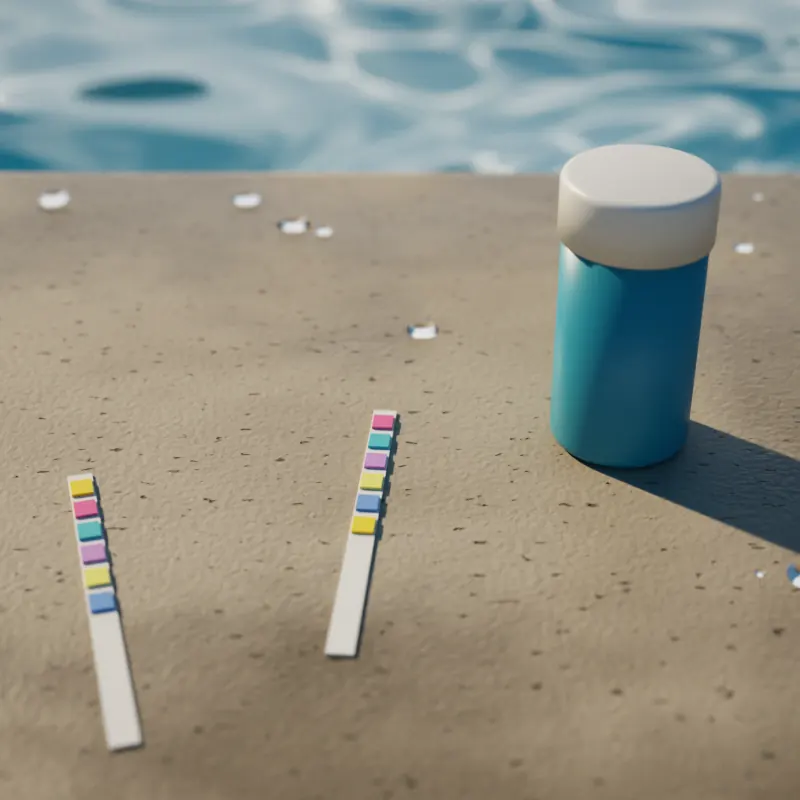
When can you soak? After the steps above, test again. Soak when free chlorine is 3 to 5 ppm and at least 7.5% of your CYA (bromine 4 to 6) and pH is 7.2 to 7.8, at least 15 minutes after adding anything (20 after pH decreaser); after chlorine, bromine or a shock, test again first. Above 5 ppm chlorine or 6 ppm bromine, wait and retest in an hour or two; never soak above 10 ppm chlorine or 8 ppm bromine, or with pH below 7.0 or above 7.8. Below 3 ppm chlorine (4 bromine), add sanitizer first; at pH 7.0 to 7.2, raise pH first; with CYA above 40 ppm, drain and refill. Hot tub limits based on CDC guidance and EPA product labels.
How to keep it from dropping again
- Test TA regularly, not only pH.
- Keep pH decreaser doses small, and let the calculator size them.
- If you use MPS often, expect to top up TA now and then.
- Test after each refill, since that resets your TA.
Common mistakes
- Adding the whole amount at once. Small steps are easier to correct than a big overshoot.
- Using soda ash to raise TA. Soda ash (pH increaser) moves pH much more. For low TA with normal pH, baking soda is the usual choice, as hot tub pH too low explains.
- Chasing pH before TA. If the buffer is low, pH won't hold. Fix TA first.
- Retesting too soon. A reading right after a dose may not show the full change. Spa Calc keeps your tests and doses in one log, so you can see what each one did.
Track it in Spa Calc
Spa Calc sizes each dose for your tub's volume and product, keeps your readings in one log, and shows whether your water is ready to soak. Get Spa Calc for iPhone and log your next test.
Sources
- Taylor Technologies: Your Pool's Total Alkalinity Explained: ranges; pH bounce; bicarbonate raises TA with little pH change.
- Bullfrog Spas: Water Care Instructions: TA range; TA before pH; small doses, jets on, wait before retesting.
- Bullfrog Spas: A Series Owner's Manual: unstable pH at low TA; no trichlor in portable spas.
- Jacuzzi: Alexa owner's manual: TA range; low TA could be corrosive.
- TroubleFreePool: Spa and Hot Tub Maintenance, A Basic Guide: spa TA range; testing a fresh fill.
- TroubleFreePool: Total Alkalinity: acid lowers TA.
- TroubleFreePool: Managing pH and Total Alkalinity: adding in steps; pH crashes at very low TA.
- TroubleFreePool: Trichlor: trichlor lowers pH and TA.
- HASA: Alkalinity Up safety data sheet: an alkalinity increaser that is sodium bicarbonate.
- Every dose and limit on this page comes from the same chemistry engine as Spa Calc.
Safety
- Keep chemicals out of reach of children and pets, and keep them out of the water until it is back in range.
- Never mix chemicals. Never add acid and chlorine together: mixing them releases toxic chlorine gas.
- Add chemicals to water, never water to chemicals.
- Store chemicals sealed, cool and dry, apart from each other.
- Read and follow the product label. It always comes first.