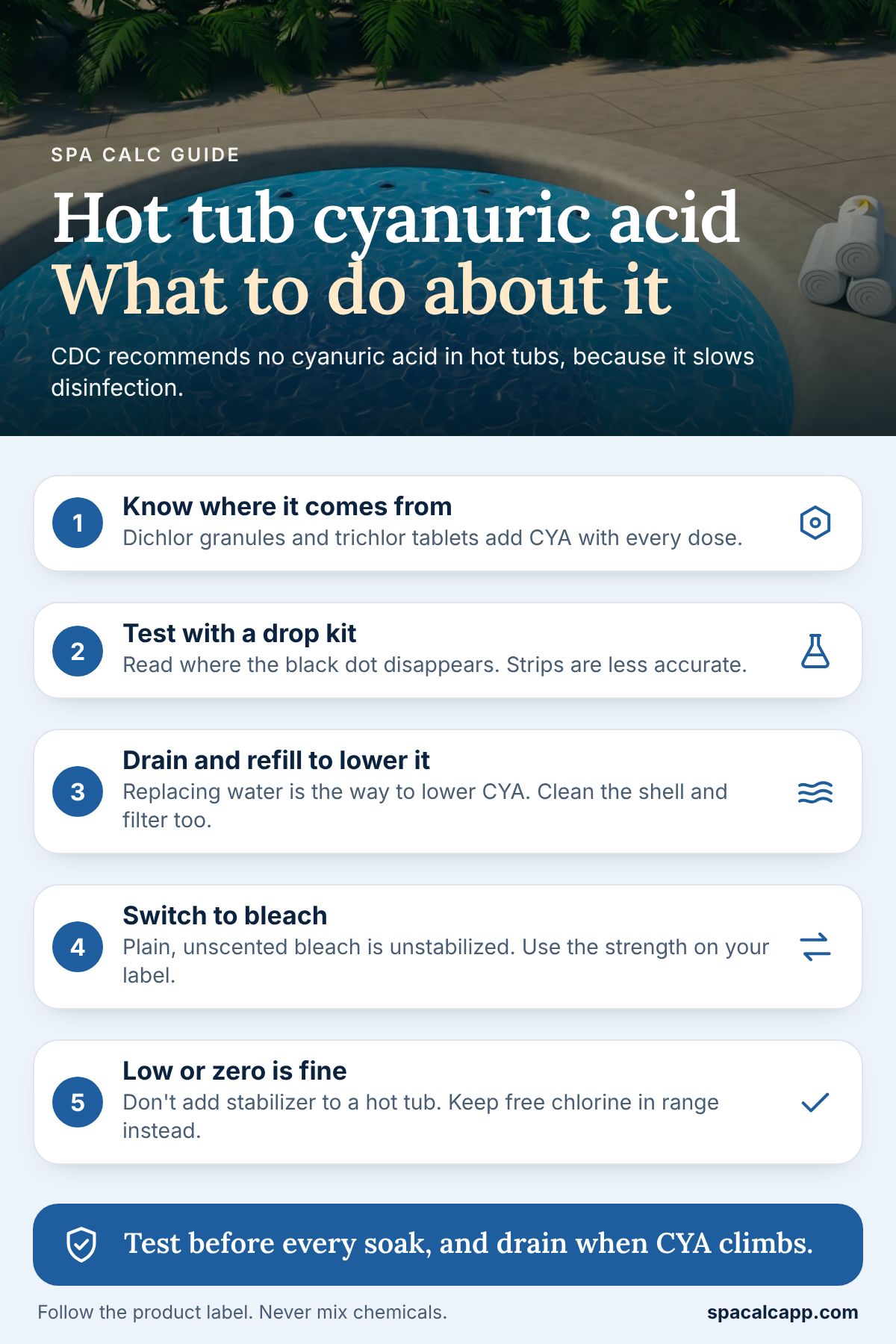
The quick answer: hot tub cyanuric acid (CYA, or stabilizer) comes mostly from dichlor granules and trichlor tablets. CDC recommends not using cyanuric acid, or chlorine products that contain it, in hot tubs, because disinfection takes longer with it. If your CYA is high, drain and refill, then use a chlorine without CYA, such as plain bleach. Spa Calc says to drain and refill above 40 ppm. A low or zero reading is fine. Follow the product label.
Hot tub chlorine calculator
Add
0.29oz
of Dichlor granules 56%
8.1 gabout 1⅞ tsp by volume
Raises free chlorine from 1 ppm to 4 ppm in 400 gal.
- Side effects: CYA +2.7 ppm, TA −1.1 ppm.
- Also raises cyanuric acid (stabilizer). It only comes down by replacing water.
- Run the jets with the lid open and wait at least 15 minutes (20 after pH decreaser) before anyone gets in.
- Pour it slowly in front of a return jet with the pump running.
Check the product label. Strengths vary by brand, so enter the % printed on yours. Add one chemical at a time, into the water, and never mix chemicals.
Use dichlor for the first week or two until stabilizer reaches about 30 ppm.
Save this test and get a reminder before your next soak.
Want this every time you test?
Spa Calc remembers your hot tub and tells you if it’s ready to soak, and what to add, every time you test.
Spa Calc for iPhone
What cyanuric acid does
TroubleFreePool's CYA article says cyanuric acid protects chlorine from being broken down by sunlight. It does that by holding on to part of the chlorine: chlorine bound to CYA is held in reserve and doesn't take part in disinfection. In a pool in full sun, that trade is worth it. A covered hot tub sees little sun, so the protection does little, and the slower disinfection remains.
That is why CDC recommends not using cyanuric acid, or chlorine products that contain it, in hot tubs. CDC's Legionella toolkit says cyanuric acid or stabilized chlorine products should not be used in hot tubs because they slow disinfection. For pools, what is CYA in a pool explains the pool side.
Where the CYA in your hot tub comes from
- Dichlor granules. The active ingredient on dichlor labels is sodium dichloro-s-triazinetrione, a stabilized chlorine. Taylor Technologies says dichlor and trichlor are more than 50% CYA by weight, so every dose adds some. TroubleFreePool's spa guide puts it plainly: using dichlor to sanitize the hot tub will also increase your CYA level.
- Trichlor tablets. CDC names dichlor and trichlor as the products that contain cyanuric acid. Bullfrog's owner's manual warns that trichlor tablets should never be used in a portable spa.
- CYA doesn't leave on its own. TroubleFreePool's CYA article says replacing water is the way to lower it, so it builds up dose after dose until you drain.
What level to keep
CDC's answer is none. If you start a new fill with dichlor, TroubleFreePool's spa guide says to switch to liquid chlorine once CYA reaches 30 ppm. Bullfrog's water balance table for its mineral system lists 0 to 50 ppm. Spa Calc uses one threshold: above 40 ppm, drain and refill.
More CYA means you need more free chlorine for the same effect. Spa Calc's soaking rule asks for free chlorine of at least 7.5% of your CYA, so at CYA 40 the minimum is 3 ppm, while the soaking limit stays at 5 ppm. As CYA climbs, that window shrinks until a dose that works is a dose you can't soak in.
How to lower cyanuric acid, step by step
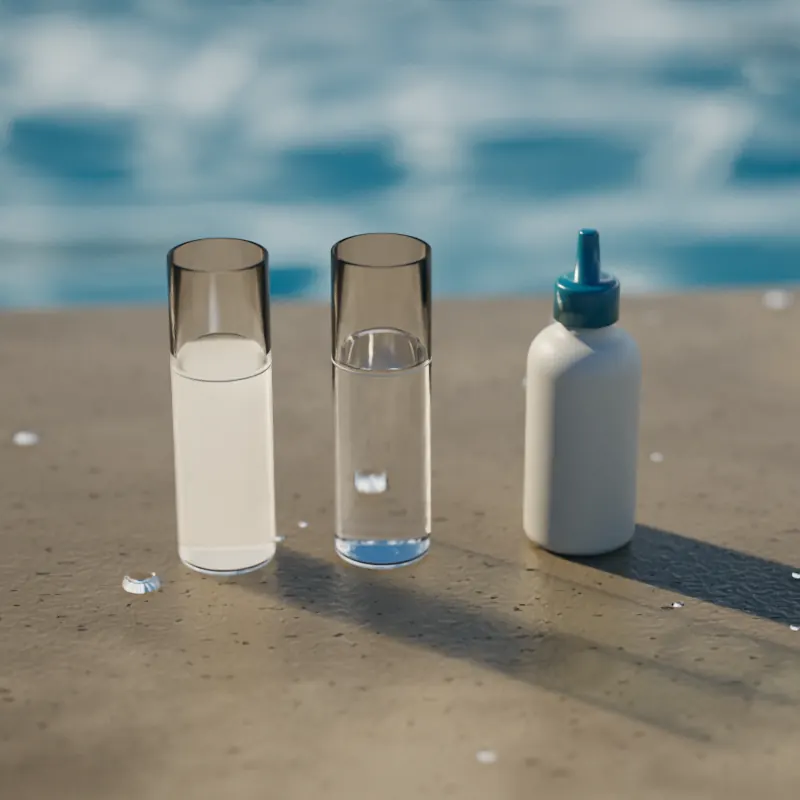
Step 1: Test CYA. Taylor Technologies describes the test: mix the sample with the CYA reagent and read where the black dot disappears. TroubleFreePool's testing article says it is the least accurate test in a kit, and that the tubes in common drop kits don't read below 20 or 30 ppm. CDC notes test strips are less accurate than drop kits. Log the reading in Spa Calc for iPhone so you can see how fast dichlor is adding to it.
Step 2: Decide. Above 40 ppm, drain and refill. Below it, you can keep going, but switch from dichlor to bleach now so it stops rising.
Step 3: Drain and refill. TroubleFreePool's CYA article says that in nearly all cases replacing water is the way to lower CYA, and Taylor Technologies points to draining with fresh water added. In a hot tub a full drain is usually the simplest. Clean the shell and filter while it's empty. How to drain a hot tub walks through it, and hot tub start up chemicals covers the new fill.
Step 4: Switch to a chlorine without CYA. Taylor Technologies suggests a switch to unstabilized chlorine while you bring CYA down. Plain, unscented bleach and liquid chlorine are unstabilized. To raise free chlorine from 0 to 3 ppm in 400 gallons takes about 2.5 fl oz (73 mL) of 6% bleach. US household bleach is sold at 6–8.25%, so use the chlorine calculator with the percentage on your label. Follow the product label. Bromine is the other route: bromine vs chlorine for hot tubs compares them.
Step 5: Test before you soak. Soak when free chlorine is 3 to 5 ppm and at least 7.5% of your CYA (bromine 4 to 6) and pH is 7.2 to 7.8, at least 15 minutes after adding anything (20 after pH decreaser); after chlorine, bromine or a shock, test again first. Above 5 ppm chlorine or 6 ppm bromine, wait and retest in an hour or two; never soak above 10 ppm chlorine or 8 ppm bromine, or with pH below 7.0 or above 7.8. Below 3 ppm chlorine (4 bromine), add sanitizer first; at pH 7.0 to 7.2, raise pH first; with CYA above 40 ppm, drain and refill. Hot tub limits based on CDC guidance and EPA product labels.
Common mistakes
- Adding stabilizer to a hot tub. CDC recommends against it, and a low or zero CYA reading is fine.
- Staying on dichlor after CYA is up. Each dose adds more. Switch to bleach once CYA reaches the point where you'd stop.
- Shocking with more dichlor to fix weak chlorine. It raises CYA further. Use an unstabilized chlorine, or drain if CYA is already high.
- Trusting a strip for CYA. Use a drop kit when the number decides whether you drain.
- Losing count of dichlor doses. Spa Calc estimates the CYA each logged dichlor dose adds and prompts you to switch to bleach at your target.
Track it in Spa Calc
Spa Calc works out each chlorine or bleach dose for your tub's volume and product strength, keeps a running estimate of the CYA your dichlor has added, and moves your drain reminder earlier when CYA is too high for chlorine. Get Spa Calc for iPhone and log your next test.
Sources
- CDC: Home Pool and Hot Tub Water Treatment and Testing: no cyanuric acid or chlorine products with it (dichlor or trichlor) in hot tubs; disinfection takes longer with cyanuric acid; at least 3 ppm chlorine in hot tubs; test strips are less accurate than drop kits.
- CDC: Controlling Legionella in Hot Tubs: cyanuric acid or stabilized chlorine products should not be used in hot tubs, as they slow disinfection.
- EPA label: BioGuard Master Dichloro Dihydrate: active ingredient sodium dichloro-s-triazinetrione dihydrate.
- TroubleFreePool Pool School: Spa & Hot Tub Maintenance, A Basic Guide: dichlor increases CYA; switch to liquid chlorine once CYA reaches 30 ppm.
- TroubleFreePool wiki: What is Cyanuric Acid (CYA)?: CYA protects chlorine from UV; chlorine bound to CYA is held in reserve; replacing water is the way to lower CYA.
- TroubleFreePool wiki: CYA Testing: black-dot turbidity test; the least accurate test in a kit; lowest readings of common tubes.
- Taylor Technologies: Why Monitoring Cyanuric Acid (CYA) Is Important: dichlor and trichlor are more than 50% CYA by weight; the black-dot test; partial draining and a switch to unstabilized chlorine.
- Bullfrog Spas: A Series Owner's Manual: never use trichlor tablets in a portable spa; cyanuric acid 0–50 ppm for its mineral system.
- Every dose and limit on this page comes from the same chemistry engine as Spa Calc.
Safety
- Keep chemicals out of reach of children and pets, and keep them out of the water until it is back in range.
- Never mix chemicals. Never add acid and chlorine together: mixing them releases toxic chlorine gas.
- Add chemicals to water, never water to chemicals.
- Store chemicals sealed, cool and dry, apart from each other.
- Read and follow the product label. It always comes first.