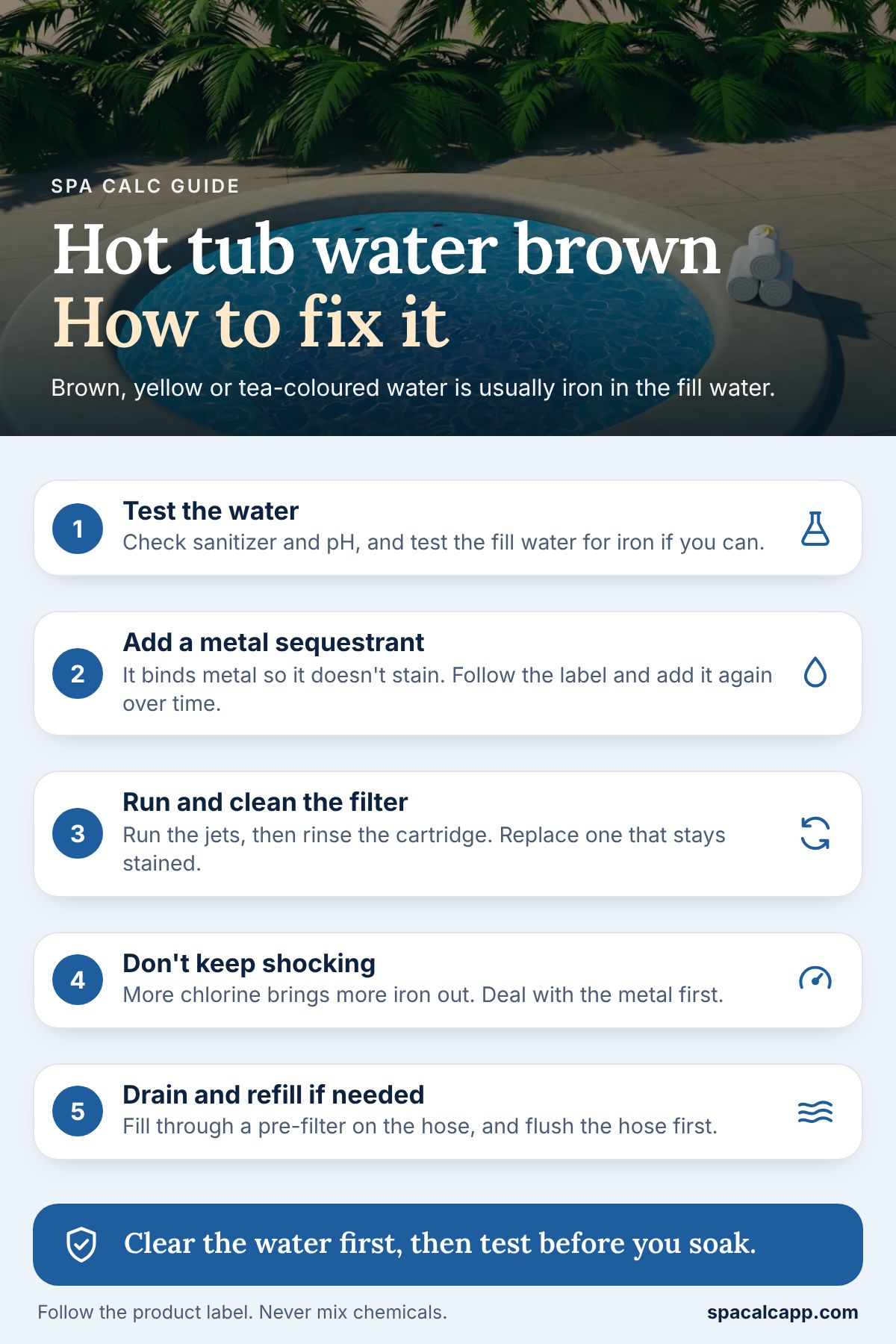
The quick answer: hot tub water brown, yellow or tea-coloured is almost always metal in the fill water, usually iron from a well. The water goes in clear, then turns colour when chlorine or bromine oxidizes the iron. Add a metal sequestrant as its label directs, run and clean the filter, and keep sanitizer in range. If the colour won't clear, drain and refill through a pre-filter. Spa Calc's soaking limits, based on CDC guidance, start at 3 ppm free chlorine.
Hot tub chlorine calculator
Add
0.29oz
of Dichlor granules 56%
8.1 gabout 1⅞ tsp by volume
Raises free chlorine from 1 ppm to 4 ppm in 400 gal.
- Side effects: CYA +2.7 ppm, TA −1.1 ppm.
- Also raises cyanuric acid (stabilizer). It only comes down by replacing water.
- Run the jets with the lid open and wait at least 15 minutes (20 after pH decreaser) before anyone gets in.
- Pour it slowly in front of a return jet with the pump running.
Check the product label. Strengths vary by brand, so enter the % printed on yours. Add one chemical at a time, into the water, and never mix chemicals.
Use dichlor for the first week or two until stabilizer reaches about 30 ppm.
Save this test and get a reminder before your next soak.
Want this every time you test?
Spa Calc remembers your hot tub and tells you if it’s ready to soak, and what to add, every time you test.
Spa Calc for iPhone
Why hot tub water turns brown
Iron in the fill water. TroubleFreePool's Pool School says iron is fairly common in well water but rare in city water, and its metals article says iron can give brown, tea-coloured water and yellow stains. Penn State Extension explains that water carrying iron or manganese can look colourless at first, then show orange-brown (iron) or black (manganese) stains or particles once it meets oxygen.
Chlorine or bromine brings it out. UMass Amherst Extension says chlorination rapidly changes dissolved iron into oxidized, coloured iron that comes out as solid particles, and that suspended iron gives water a red or yellow tint. That's why so many owners see brown water right after the first dose of chlorine on a new fill. TroubleFreePool adds that high pH and high free chlorine are the conditions metals like least, so a shock can bring them out too.
Copper. TroubleFreePool links copper to green water and dark stains. If your water is green rather than brown, see hot tub green water.
Not metals? Brown water with debris, a slimy feel or a smell points to dirt and low sanitizer instead. Cloudy hot tub water covers that.
How to fix brown hot tub water, step by step
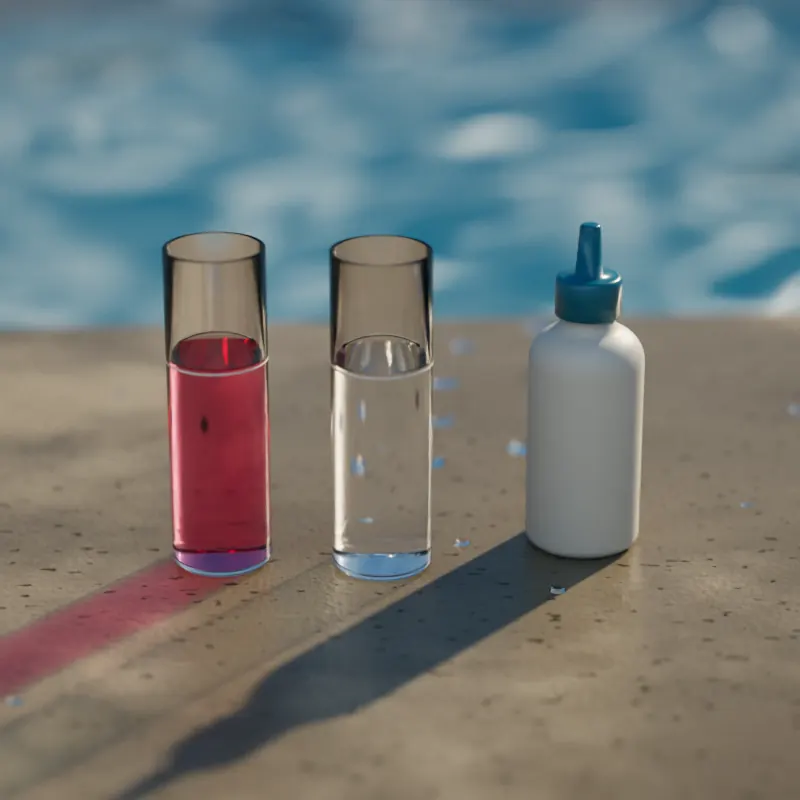
Step 1: Test the water. Check free chlorine or bromine and pH. CDC's hot tub guidance gives chlorine of at least 3 ppm, bromine of 4–8 ppm and pH of 7.0–7.8. If you can, test the fill water for iron: Taylor Technologies suggests monitoring iron and manganese in make-up water such as well water, and sells iron test kits. Log the readings in Spa Calc for iPhone so you can tie the colour to a fill or a dose.
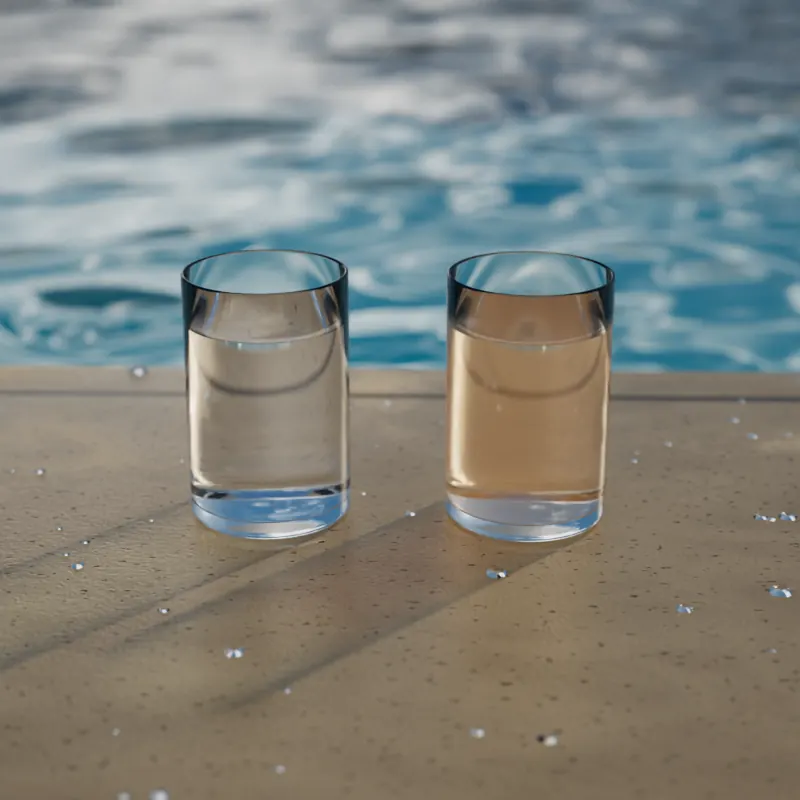
Step 2: Add a metal sequestrant. These are sold as metal control or stain and scale products. TroubleFreePool explains that a sequestrant binds to metal so it doesn't deposit as stains, and that it breaks down over time, so it needs adding again. Bullfrog's owner's manual says source water high in iron or other metals may need a metal control product. Follow the product label for the amount and for how long to wait before adding other chemicals.
Step 3: Run the filter and clean it. Particles that the filter catches leave the water. Run the jets with the cover open, then rinse the cartridge. Bullfrog's manual says to clean or replace the filter every 4 weeks, and Hot Spring's quick start guide says to clean filter cartridges monthly to remove debris and mineral buildup. Replace a cartridge that stays stained.
Step 4: Keep sanitizer in range, without overdoing it. Bring free chlorine back into range after the sequestrant has had time to work, as its label directs. To raise free chlorine from 0 to 3 ppm in 400 gallons takes about 2.5 fl oz (73 mL) of 6% bleach. US household bleach is sold at 6–8.25%, so use the chlorine calculator with the percentage on your label. Follow the product label. Use plain, unscented bleach.
Step 5: Drain and refill if it won't clear. In a small tub, fresh water is often the quickest fix. Bullfrog's manual says water that looks off-colour needs to be treated or drained. Hot Spring and Caldera both recommend filling through a pre-filter on the hose, and flushing the hose first. Add a sequestrant to the new fill as its label directs. How to drain a hot tub walks through it, and hot tub start up chemicals covers the new fill.
When can you soak? Clear the water first. Then test: Soak when free chlorine is 3 to 5 ppm and at least 7.5% of your CYA (bromine 4 to 6) and pH is 7.2 to 7.8, at least 15 minutes after adding anything (20 after pH decreaser); after chlorine, bromine or a shock, test again first. Above 5 ppm chlorine or 6 ppm bromine, wait and retest in an hour or two; never soak above 10 ppm chlorine or 8 ppm bromine, or with pH below 7.0 or above 7.8. Below 3 ppm chlorine (4 bromine), add sanitizer first; at pH 7.0 to 7.2, raise pH first; with CYA above 40 ppm, drain and refill. Hot tub limits based on CDC guidance and EPA product labels.
How to prevent brown water
- Know your fill water. Caldera's quick start guide suggests having a fill-water sample checked for metals. Bullfrog's manual says to see your dealer before filling with water high in iron or other metals.
- Fill through a pre-filter on the hose, and flush the hose first.
- Add a sequestrant on every new fill, and again as its label directs, since it breaks down.
- Keep pH in range. TroubleFreePool notes that stains often appear soon after pH is raised. Raise pH in small steps and retest.
Common mistakes
- Shocking brown water again and again. More chlorine brings more iron out of solution. Deal with the metal first, then bring sanitizer back into range.
- Mixing up the products. Add one chemical at a time, as each label directs, and never mix them.
- Refilling from the same source with no pre-filter. The colour comes straight back.
- Losing track of fills and doses. Spa Calc keeps each reading and dose in one log, so you can see whether the colour follows a new fill or a shock.
Track it in Spa Calc
Spa Calc works out each dose for your tub's volume and the product you use, and tells you whether your readings are in range for a soak, based on CDC guidance. Get Spa Calc for iPhone and log your next test.
Sources
- TroubleFreePool Pool School: Metals: iron can cause brown, tea-coloured water and yellow stains; copper green water; high pH and high FC are the conditions least favourable to metals.
- TroubleFreePool Pool School: Stains in Your Pool: iron is common in well water and rare in city water; stains often appear after pH is raised or chlorine added; sequestrants bind metals and must be re-added.
- Penn State Extension: Iron and Manganese in Private Water Systems: water can look colourless, then show orange-brown or black particles once exposed to oxygen.
- UMass Amherst Extension: Iron and Manganese in Private Drinking Water Wells: chlorination turns dissolved iron into coloured particles; suspended iron gives water a red or yellow tint.
- Taylor Technologies: Know Your Make-Up Water: monitor iron and manganese in make-up water such as well water.
- Bullfrog Spas: A Series Owner's Manual: see a dealer before filling with water high in iron or other metals; metal control product; off-colour water needs treating or draining; clean or replace the filter every 4 weeks.
- Hot Spring: Hot Spot Collection Quick Start Guide: fill through a pre-filter and flush the hose first; iron and copper can stain the shell; clean filter cartridges monthly.
- Caldera Spas: Vacanza Series Quick Start Guide: fill through a pre-filter; have fill water checked for metals.
- CDC: What You Can Do to Stay Healthy in Hot Tubs: chlorine at least 3 ppm, bromine 4–8 ppm, pH 7.0–7.8.
- Every dose and limit on this page comes from the same chemistry engine as Spa Calc.
Safety
- Keep chemicals out of reach of children and pets, and keep them out of the water until it is back in range.
- Never mix chemicals. Never add acid and chlorine together: mixing them releases toxic chlorine gas.
- Add chemicals to water, never water to chemicals.
- Store chemicals sealed, cool and dry, apart from each other.
- Read and follow the product label. It always comes first.