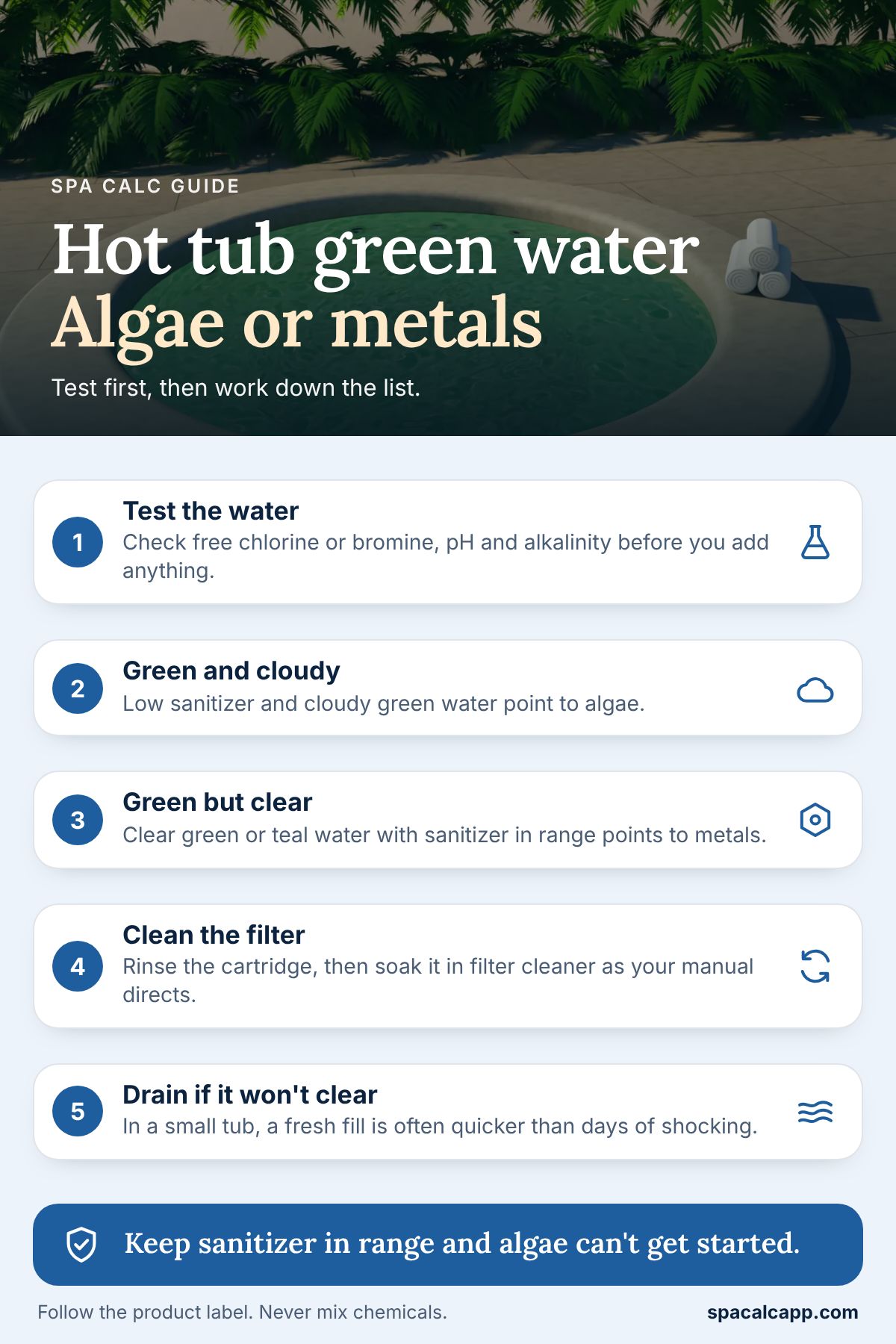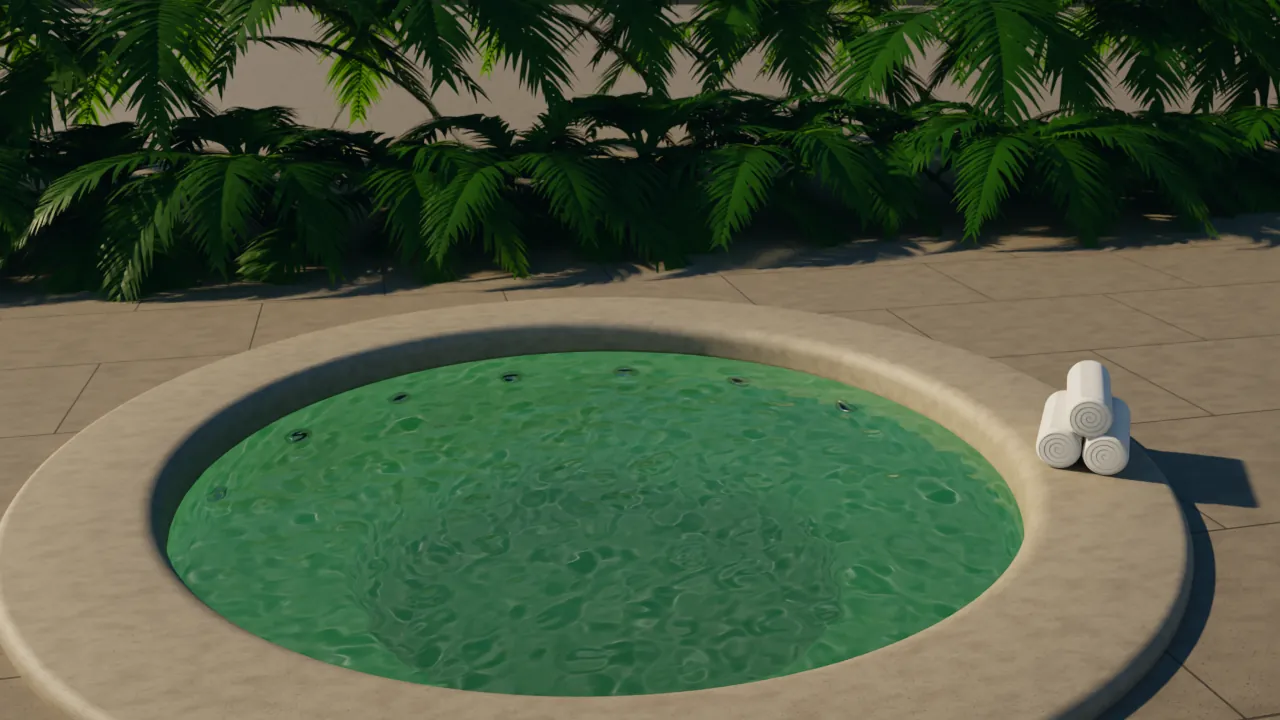
The quick answer: hot tub green water is usually either algae, which grows when sanitizer runs low, or metals such as copper or iron. Test sanitizer and pH first. Low sanitizer and cloudy green water point to algae: clean the filter, shock, and often drain and refill. Clear green or teal water with sanitizer in range points to metals. Follow the product label for anything you add.
All-in-one hot tub calculator
Not safe: do not get in yet.
Two things to fix. Start with ph.
pH 7.9 → 7.5
Lower it
Add
0.42oz
of Dry acid / pH minus (sodium bisulfate 93%)
12 gabout 2⅛ tsp by volume
- Side effects: TA −3 ppm.
- Run the jets with the lid open and wait at least 15 minutes (20 after pH decreaser) before anyone gets in.
- Never add acid and chlorine together or in the same spot: mixing them releases toxic chlorine gas. Let the first one circulate before adding the other (the wait is shown on each step).
Then wait 15 minutes with the jets running.
Free chlorine 1 ppm → 4 ppm
Raise it
Add
0.29oz
of Dichlor granules 56%
8.1 gabout 1⅞ tsp by volume
- Side effects: CYA +2.7 ppm, TA −1.1 ppm.
- Also raises cyanuric acid (stabilizer). It only comes down by replacing water.
- Run the jets with the lid open and wait at least 15 minutes (20 after pH decreaser) before anyone gets in.
- Free chlorine is below the minimum for your stabilizer level.
- Use dichlor for the first week or two until stabilizer reaches about 30 ppm.
In range
- CYA 20 ppm
- TA 70 ppm
- Use dichlor for the first week or two until stabilizer reaches about 30 ppm.
Check the product label. Strengths vary by brand, so enter the % printed on yours. Add one chemical at a time, into the water, and never mix chemicals.
- CDC recommends not using stabilizer (cyanuric acid) in hot tubs, because it slows chlorine down. The dichlor-then-bleach method keeps it to about 30 to 40 ppm; bleach only keeps it at zero.
Save this test and get a reminder before your next soak.
Want this every time you test?
Spa Calc remembers your hot tub and tells you if it’s ready to soak, and what to add, every time you test.
Spa Calc for iPhone
Algae or metals: how to tell
- Algae. TroubleFreePool's algae guide says that if you keep free chlorine at the right level at all times, algae can't get started. Early algae shows as dull water and a sanitizer reading that falls faster than usual. Green, cloudy water with low or zero chlorine or bromine is the classic sign. Warm water and heavy use eat sanitizer quickly, so a tub can turn in a few days.
- Metals. TroubleFreePool explains that iron can turn water orange, brown, yellow or green once it comes out of solution, and that iron is fairly common in well water. Common copper sources are mineral systems, ionizers and copper heater parts worn down by pH below 7.2. Brown or yellow water is covered in hot tub water brown.
- The test that decides it. If sanitizer has stayed in range the whole time and the water is still green, algae is unlikely. Look at metals.
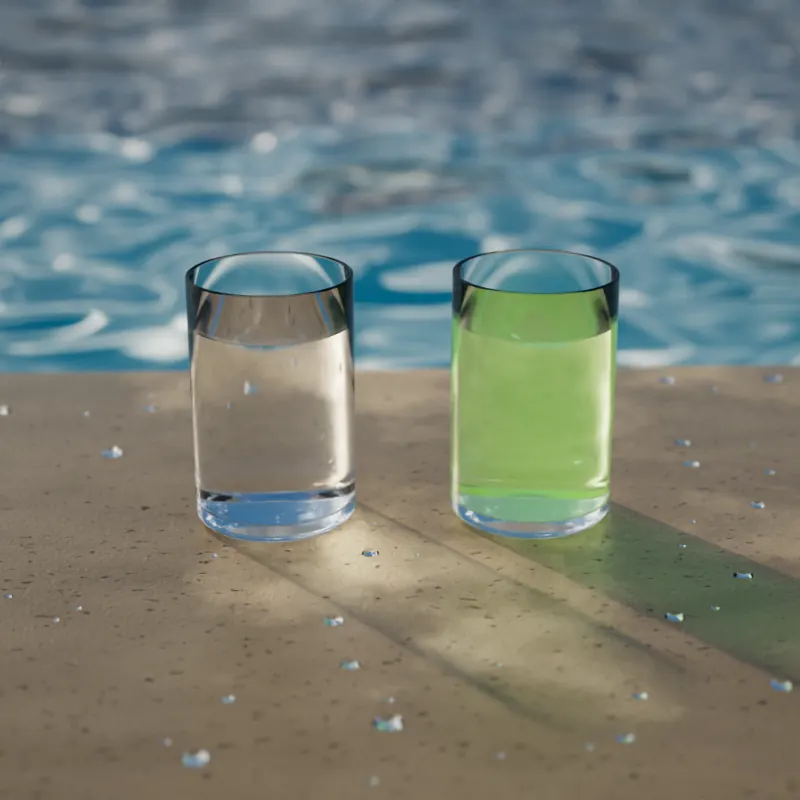
How to fix green hot tub water, step by step
Step 1: Test the water. Check free chlorine or bromine, pH and alkalinity before you add anything. CDC's hot tub guidance gives free chlorine of 3–10 ppm, bromine of 4–8 ppm and pH of 7.2–7.8. Write the readings down in Spa Calc for iPhone, so you can tell later whether the green followed low sanitizer.
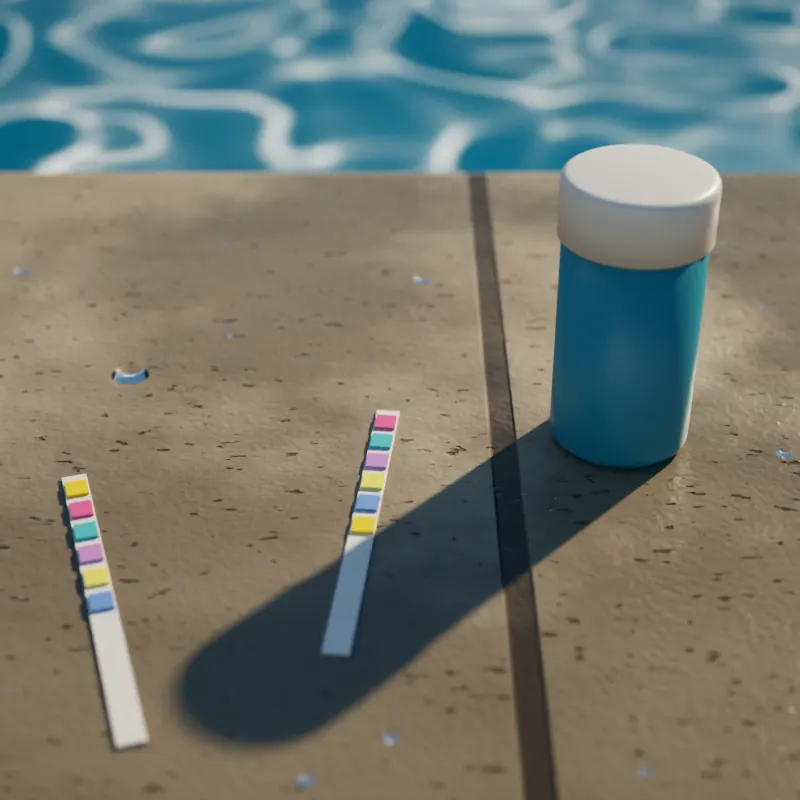
Step 2: Clean or replace the filter. Algae and debris collect in the cartridge. Rinse it, then soak it in filter cleaner as your tub's manual directs. CDC's hot tub guidance says to clean or replace filters as the manufacturer recommends. Replace a cartridge that stays stained.
Step 3: For algae, shock and run the circulation. Raise sanitizer as the shock product's label directs, with the cover open and the jets running. To bring chlorine from 0 to 5 ppm in 400 gallons takes about 4.1 fl oz (122 mL) of 6% bleach, or 13.5 g of 56% dichlor. US household bleach is sold at 6–8.25%, so use the chlorine calculator with the percentage on your label. CDC recommends not using cyanuric acid or products that contain it, such as dichlor, in hot tubs. Bleach adds none. Retest after a few hours and top up if the reading drops fast, as it will while algae is being killed.
Step 4: Drain, clean and refill if the green won't clear. In a tub this small, a fresh fill is often quicker and cheaper than days of shocking. CDC's hot tub guidance says to scrub surfaces when the tub is drained, to deal with biofilm. TroubleFreePool's spa guide also suggests flushing the lines before you drain and soaking the filter. How to drain a hot tub walks through it, and hot tub start up chemicals covers the new fill.
Step 5: For metals, start with the fill water. Test your fill water once the tub is full, as TroubleFreePool's spa guide suggests. TroubleFreePool explains that sequestrants bind metals so they don't drop out as stains, and that they break down over time and need to be added again. If you use one, follow the product label. Keep pH from sliding below 7.2, because low pH wears copper heater parts.
When can you soak? First clear the water. Then test: Soak when free chlorine is 3 to 5 ppm and at least 7.5% of your CYA (bromine 4 to 6) and pH is 7.2 to 7.8, at least 15 minutes after adding anything (20 after pH decreaser); after chlorine, bromine or a shock, test again first. Above 5 ppm chlorine or 6 ppm bromine, wait and retest in an hour or two; never soak above 10 ppm chlorine or 8 ppm bromine, or with pH below 7.0 or above 7.8. Below 3 ppm chlorine (4 bromine), add sanitizer first; at pH 7.0 to 7.2, raise pH first; with CYA above 40 ppm, drain and refill. Hot tub limits based on CDC guidance and EPA product labels.
Green and cloudy, green after shock, green after filling
- Green and cloudy: almost always algae with low sanitizer. Follow steps 1 to 4.
- Green after shock: if the reading is still in range and the water is clear but tinted, metals are the likelier cause. Follow step 5. If it's also hazy, see hot tub cloudy after shock.
- Green after filling: check the fill water for metals, especially well water.
How to keep it from coming back
- Test before each soak and keep sanitizer in range. CDC suggests testing hot tubs at least twice a day in public settings, and more after heavy use.
- Rinse the filter often and keep a clean spare.
- Keep pH in range, especially if your tub has a copper heater or a mineral system.
- Drain on schedule. At 2 soakers a day, a 400-gallon tub is due about every 67 days. How often to drain a hot tub explains the math.
Common mistakes
- Adding more shock to metal-green water. If sanitizer is already in range, more shock won't fix a metal tint.
- Skipping the filter. Algae left in the cartridge seeds the next bloom.
- Soaking while it's green. Clear and test it first.
- Losing track of readings. Spa Calc keeps each test and dose in one log, so you can see whether the green followed low sanitizer or a fresh fill.
Track it in Spa Calc
Spa Calc sizes each dose for your tub's volume and product, keeps your readings in one log, and shows whether your water is ready to soak. Get Spa Calc for iPhone and log your next test.
Sources
- TroubleFreePool Pool School: Defeating Algae: algae can't get started when free chlorine is kept at the right level; early signs.
- TroubleFreePool Pool School: Stains in Your Pool: iron is common in well water and can turn water green; copper sources include ionizers, mineral systems and copper heaters worn by low pH; how sequestrants work.
- TroubleFreePool: Spa and Hot Tub Maintenance, A Basic Guide: flushing lines, soaking filters at each drain, testing fill water.
- CDC: Controlling Legionella in Hot Tubs: free chlorine 3–10 ppm, bromine 4–8 ppm, pH 7.2–7.8; test at least twice a day; scrub surfaces when drained; clean or replace filters as the manufacturer recommends.
- CDC: Home Pool and Hot Tub Water Treatment and Testing: no cyanuric acid in hot tubs.
- Every dose and limit on this page comes from the same chemistry engine as Spa Calc.
Safety
- Keep chemicals out of reach of children and pets, and keep them out of the water until it is back in range.
- Never mix chemicals. Never add acid and chlorine together: mixing them releases toxic chlorine gas.
- Add chemicals to water, never water to chemicals.
- Store chemicals sealed, cool and dry, apart from each other.
- Read and follow the product label. It always comes first.